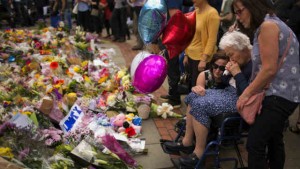
 Slaughter caused by a suicide bomber just outside a Manchester concert proves once again jihadi terrorists will stop at nothing to destroy our way of life.
In the very week the Lindt Café Siege inquiry hands down its report, we are faced with authorities scrambling to make sense of the senseless taking of more innocent lives, many of them teens.
While police have named British-born 22-year-old Salman Abedi as the man who detonated the improvised bomb, packed with shrapnel, Islamic State claimed responsibility for the attack — lauding the actions of one of “the soldiers of the Caliphate” and warning in a video “there is more to come”.
The pattern in Manchester is now all too familiar from other atrocities committed by Islamist terrorists around the world.
Random, deadly attacks launched against ordinary members of the public are becoming commonplace in western democracies.
UK Home Secretary Amber Rudd said the Manchester explosion was a ‘barbaric act’. But now there is a connection between the bomber and radical Islam, we know what will happen next.
Politicians will go out of their way to explain that the terrorist was not — and could not have been — acting in the name of Islam. Islam and barbarism are incompatible, they will tell us.
And, indeed, fear of being branded ‘Islamophobic’ stifles many politicians, journalists, and community leaders from criticising Islam. They prefer to say attacks are a ‘perversion’ of Islam.
But a harder question is whether jihadist violence actually has deep doctrinal, scriptural, and historical roots in mainstream Islam. There is great pressure to avoid asking that question.
Whatever the Qu’ran actually says about violence, it is clear that Islam provides an ideological framework giving suicidal psychopaths the sense of purpose that motivates them to act.
Jihadist attacks perpetrated by so-called ‘lone wolf’ killers who intend to kill as many as possible, end, almost invariably, with the death of the attacker. This is no accident.
The terrorist’s death is not an unfortunate consequence of his or her action: it is a central part of the plan. Jihadists choose death and are determined to die. Their aim is rejection, not reform.
According to Olivier Roy, an expert on political Islam and Islamist terrorism, “Violence is not a means. It is an end in itself. It is violence devoid of a future.”
We struggle to understand what drives an individual – usually male, often young, and with their whole life before them – to perpetrate such nihilistic and suicidal atrocities.
Our societies are under attack. Acts of terror committed in the name of Islam pose a growing challenge for western countries long accustomed to the conventions of tolerance and liberty.
And terrorists hold the upper hand. “It’s a numbers game,” says one expert. With so many suspects, he says, “it is impossible for security services to keep track of everyone that is of concern.”
As recently as yesterday, police in Adelaide detained a 22-year old Somali-Australian woman who has been charged with being a member of Islamic State. But for every suspect caught, many more are likely to slip through the police net.
What is to be done? Ramping up security in all public arenas will continue, but in reality it can offer only limited protection — until the next attack, followed by yet more heightened measures.
But increased security can only be part of a short-term response. Dislodging violent ideas from the heads of death-obsessed religious extremists takes more than imposing more bag checks.
Rather, it means renewing our commitment to liberty, tolerance, and the rule of law. It means reclaiming the values of western civilisation — and instilling those values in every citizen.
It also means encouraging open discussion about religious ideas — including criticism of religion — without fear of attack or legal action under the guise of stamping out ‘Islamophobia’.
This is no quick-fix solution, mind you. It will take a long time, and it will not eliminate the threat of religious violence altogether. But it will temper the environment in which such violence breeds.
Religious violence is provoking a deadly contest about our fundamental beliefs. Each one of us is now engaged in that contest – and we need to know what it is that we must defend.
Peter Kurti is a Research Fellow at the Centre for Independent Studies

Home > Commentary > Opinion > A contest of minds
A contest of minds
In the very week the Lindt Café Siege inquiry hands down its report, we are faced with authorities scrambling to make sense of the senseless taking of more innocent lives, many of them teens.
While police have named British-born 22-year-old Salman Abedi as the man who detonated the improvised bomb, packed with shrapnel, Islamic State claimed responsibility for the attack — lauding the actions of one of “the soldiers of the Caliphate” and warning in a video “there is more to come”.
The pattern in Manchester is now all too familiar from other atrocities committed by Islamist terrorists around the world.
Random, deadly attacks launched against ordinary members of the public are becoming commonplace in western democracies.
UK Home Secretary Amber Rudd said the Manchester explosion was a ‘barbaric act’. But now there is a connection between the bomber and radical Islam, we know what will happen next.
Politicians will go out of their way to explain that the terrorist was not — and could not have been — acting in the name of Islam. Islam and barbarism are incompatible, they will tell us.
And, indeed, fear of being branded ‘Islamophobic’ stifles many politicians, journalists, and community leaders from criticising Islam. They prefer to say attacks are a ‘perversion’ of Islam.
But a harder question is whether jihadist violence actually has deep doctrinal, scriptural, and historical roots in mainstream Islam. There is great pressure to avoid asking that question.
Whatever the Qu’ran actually says about violence, it is clear that Islam provides an ideological framework giving suicidal psychopaths the sense of purpose that motivates them to act.
Jihadist attacks perpetrated by so-called ‘lone wolf’ killers who intend to kill as many as possible, end, almost invariably, with the death of the attacker. This is no accident.
The terrorist’s death is not an unfortunate consequence of his or her action: it is a central part of the plan. Jihadists choose death and are determined to die. Their aim is rejection, not reform.
According to Olivier Roy, an expert on political Islam and Islamist terrorism, “Violence is not a means. It is an end in itself. It is violence devoid of a future.”
We struggle to understand what drives an individual – usually male, often young, and with their whole life before them – to perpetrate such nihilistic and suicidal atrocities.
Our societies are under attack. Acts of terror committed in the name of Islam pose a growing challenge for western countries long accustomed to the conventions of tolerance and liberty.
And terrorists hold the upper hand. “It’s a numbers game,” says one expert. With so many suspects, he says, “it is impossible for security services to keep track of everyone that is of concern.”
As recently as yesterday, police in Adelaide detained a 22-year old Somali-Australian woman who has been charged with being a member of Islamic State. But for every suspect caught, many more are likely to slip through the police net.
What is to be done? Ramping up security in all public arenas will continue, but in reality it can offer only limited protection — until the next attack, followed by yet more heightened measures.
But increased security can only be part of a short-term response. Dislodging violent ideas from the heads of death-obsessed religious extremists takes more than imposing more bag checks.
Rather, it means renewing our commitment to liberty, tolerance, and the rule of law. It means reclaiming the values of western civilisation — and instilling those values in every citizen.
It also means encouraging open discussion about religious ideas — including criticism of religion — without fear of attack or legal action under the guise of stamping out ‘Islamophobia’.
This is no quick-fix solution, mind you. It will take a long time, and it will not eliminate the threat of religious violence altogether. But it will temper the environment in which such violence breeds.
Religious violence is provoking a deadly contest about our fundamental beliefs. Each one of us is now engaged in that contest – and we need to know what it is that we must defend.
Peter Kurti is a Research Fellow at the Centre for Independent Studies
• Subscribe
Subscribe now and stay in the loop with our giving appeals, event alerts, newsletters and research updates.
We are always pleased to hear from you. If you have any questions or feedback, please contact us here: