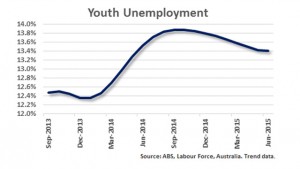
 Despite recent easing, youth unemployment remains worryingly high following a flood of jobless youngsters since the start of 2014. Yet underlying data shows that youth unemployment has spiked not through outright lay-offs, but due to the positive activation of young Australians, with increasing labour market participation and employment figures.
Momentum should be built in Australia to assist the low-skilled, unexperienced youth to secure a toehold in the job market. Measures to enhance productivity and reduce regulatory burdens should be top priority.
Since the Global Financial Crisis, unemployment rates for young people aged between 15 and 24 years old have surged from a record low trend of 8.7% in early 2008 to over 13.4% in recent months. Although not as high as the levels experienced in 1980s/90s, the escalation of the problem has completely wiped out the gains made throughout the mining boom years of mid-2000s.
Yet microanalysis of the latest trend burst (chart above) reveals some new silver linings in Australia’s youth labour market dynamics. Not only have youth unemployment rates probably passed the recent peak, but the increase since last year was mainly due to more people looking for work — and therefore now officially being counted as unemployed — at the same time as youth employment figures were actually rising.
This demonstrates that, contrary to what overall youth unemployment rates might suggest, labour market conditions have improved in the last 18 months when labour market youth participation is taken into account. More than 55,000 young people were added to the labour force, including a net addition of 28,000 young workers.
Additionally, the disaggregation of youth labour data into two cohorts — teenagers (aged 15 to 19) and early 20s (20-24) — offer an even better picture of losers and winners in this recovery process.
On the one hand, Australian teenage unemployment rates, at 19.5%, are currently at an all-time high since 1997, after a steady increase of three percentage points since early last year, in part due to large numbers of jobs being axed for this age bracket in retail and construction industries.
Early 20s jobseekers are faring much better in the recent labour market improvements with more than 35,000 net job openings in the last nine months, leading to an all-time record high employment figure of 1.2 million workers aged between 20 and 24. In addition, unemployment rates for early 20s, at 9.7%, are the lowest since the beginning of 2014 despite the increase in jobseekers for that age bracket.
Recent underlying improvements in the data do not mean a crisis in the youth labour force has been averted. Australia still has roughly 300,000 young unemployed — almost double pre-GFC levels — with potential damaging long-term consequences for their lives and career prospects.
So what can be done to avoid the scarring effects of youth unemployment in Australia?
More economic growth would be an effective remedy. Unemployment rates — no matter the age bracket — respond strongly to economic activity. Yet the current scenario with many international and domestic risks is not particularly encouraging.
Nonetheless, with respect to the young labour force, mainly working on retail trade, hospitality and construction, eliminating some unnecessary demand-side barriers to employment would by itself significantly improve the situation.
For instance, some prohibitive regulatory pay floors — such as an entry-level minimum casual pay for a 20-year-old in the fast food industry of up to $29/hr on a Sunday, or a substantial $46/hr on public holidays — should be dropped, paving the way to more job creation for the youth.
Additionally, some of the Harper Competition Policy Review recommendations demand serious consideration. For example, trading hour restrictions should be abolished, accommodating Gen-Y’s propensity to want to work outside the traditional 9-to-5 schedule. Proper regulation of new markets and disruptive technologies, such as ride-sharing ventures, could unleash entrepreneurial spirits among youth. Less restrictive planning laws would add demand for a whole new horde of young workers on the construction industry.
There is a silver lining in the youth unemployment issue. The increasing number of young Australians looking for a job should send a loud and clear message to both state and federal politicians for a shake-up in the workplace regulations and the competitive environment. Let the kids work — and they will.

Home > Commentary > Opinion > Silver linings in recent youth unemployment data
Silver linings in recent youth unemployment data
Momentum should be built in Australia to assist the low-skilled, unexperienced youth to secure a toehold in the job market. Measures to enhance productivity and reduce regulatory burdens should be top priority.
Since the Global Financial Crisis, unemployment rates for young people aged between 15 and 24 years old have surged from a record low trend of 8.7% in early 2008 to over 13.4% in recent months. Although not as high as the levels experienced in 1980s/90s, the escalation of the problem has completely wiped out the gains made throughout the mining boom years of mid-2000s.
Yet microanalysis of the latest trend burst (chart above) reveals some new silver linings in Australia’s youth labour market dynamics. Not only have youth unemployment rates probably passed the recent peak, but the increase since last year was mainly due to more people looking for work — and therefore now officially being counted as unemployed — at the same time as youth employment figures were actually rising.
This demonstrates that, contrary to what overall youth unemployment rates might suggest, labour market conditions have improved in the last 18 months when labour market youth participation is taken into account. More than 55,000 young people were added to the labour force, including a net addition of 28,000 young workers.
Additionally, the disaggregation of youth labour data into two cohorts — teenagers (aged 15 to 19) and early 20s (20-24) — offer an even better picture of losers and winners in this recovery process.
On the one hand, Australian teenage unemployment rates, at 19.5%, are currently at an all-time high since 1997, after a steady increase of three percentage points since early last year, in part due to large numbers of jobs being axed for this age bracket in retail and construction industries.
Early 20s jobseekers are faring much better in the recent labour market improvements with more than 35,000 net job openings in the last nine months, leading to an all-time record high employment figure of 1.2 million workers aged between 20 and 24. In addition, unemployment rates for early 20s, at 9.7%, are the lowest since the beginning of 2014 despite the increase in jobseekers for that age bracket.
Recent underlying improvements in the data do not mean a crisis in the youth labour force has been averted. Australia still has roughly 300,000 young unemployed — almost double pre-GFC levels — with potential damaging long-term consequences for their lives and career prospects.
So what can be done to avoid the scarring effects of youth unemployment in Australia?
More economic growth would be an effective remedy. Unemployment rates — no matter the age bracket — respond strongly to economic activity. Yet the current scenario with many international and domestic risks is not particularly encouraging.
Nonetheless, with respect to the young labour force, mainly working on retail trade, hospitality and construction, eliminating some unnecessary demand-side barriers to employment would by itself significantly improve the situation.
For instance, some prohibitive regulatory pay floors — such as an entry-level minimum casual pay for a 20-year-old in the fast food industry of up to $29/hr on a Sunday, or a substantial $46/hr on public holidays — should be dropped, paving the way to more job creation for the youth.
Additionally, some of the Harper Competition Policy Review recommendations demand serious consideration. For example, trading hour restrictions should be abolished, accommodating Gen-Y’s propensity to want to work outside the traditional 9-to-5 schedule. Proper regulation of new markets and disruptive technologies, such as ride-sharing ventures, could unleash entrepreneurial spirits among youth. Less restrictive planning laws would add demand for a whole new horde of young workers on the construction industry.
There is a silver lining in the youth unemployment issue. The increasing number of young Australians looking for a job should send a loud and clear message to both state and federal politicians for a shake-up in the workplace regulations and the competitive environment. Let the kids work — and they will.
• Subscribe
Subscribe now and stay in the loop with our giving appeals, event alerts, newsletters and research updates.
We are always pleased to hear from you. If you have any questions or feedback, please contact us here: